Best accounting software for startups in 2026: 8 ranked
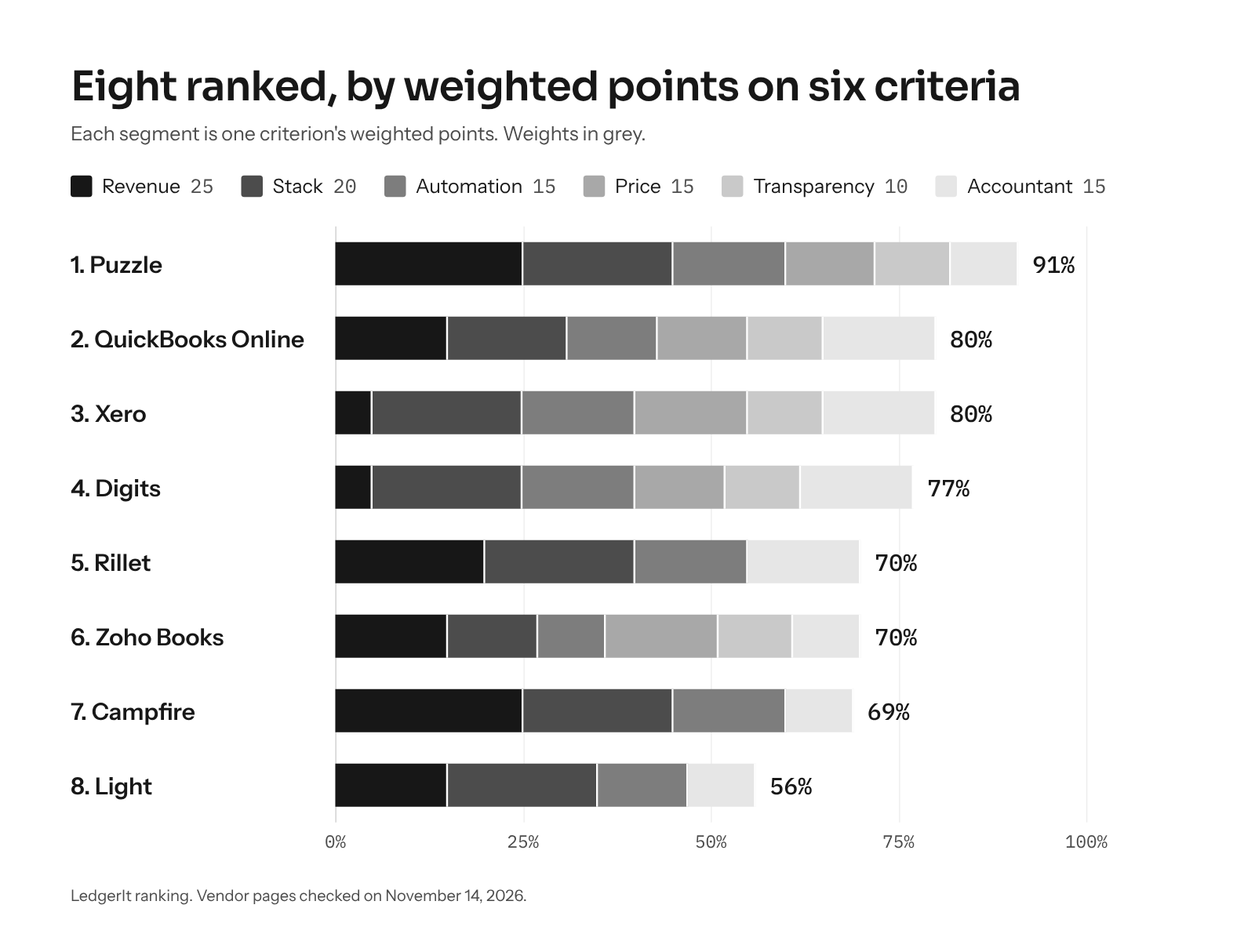
Puzzle scores 91%, QuickBooks Online and Xero 80%, on a published rubric for a seed-stage SaaS company on Stripe. Prices checked on each vendor's page.
By The LedgerIt team16 min read
Puzzle is the best accounting software for a seed-stage B2B SaaS startup on Stripe in 2026, at 91%: it turns Stripe invoices into revenue schedules on a published $100 a month plan and connects Mercury, Brex, Ramp, Gusto and Rippling directly. QuickBooks Online is next at 80%, for a company whose accountant already works in QuickBooks, and Xero ties it at 80%, for the lowest published price with unlimited free users.
Every score below comes from the vendor's own pages, read on the day this was published, and the rubric is written out so you can redo the sum with your own weights. LedgerIt sells a competing product and is not ranked.
At a glance
| Rank | Product | Best for | Entry price | Score |
|---|---|---|---|---|
| 1 | Puzzle | A seed-stage SaaS company on Stripe that wants revenue recognition from Stripe at a published price | $60 a month (Core, billed annually) | 91% |
| 2 | QuickBooks Online | A startup whose accountant already works in QuickBooks | $85 a month (Essentials, billed monthly) | 80% |
| 3 | Xero | The lowest published price, with unlimited free users | $27 a month (Early, billed monthly) | 80% |
| 4 | Digits | AI bookkeeping with unlimited seats, before you have deferred revenue | $65 a month (Essentials, billed monthly) | 77% |
| 5 | Rillet | A Series A SaaS company with contracts in a CRM and a controller | Not published | 70% |
| 6 | Zoho Books | An invoice-billing startup on a tight budget | $15 a month (Standard, billed annually) | 70% |
| 7 | Campfire | Stripe revenue recognition and an AI-run close, sold by quote | Not published | 69% |
| 8 | Light | A startup with entities in several countries | Not published | 56% |
"Entry price" is the cheapest plan with more than one user that keeps accrual books, billed annually where the vendor shows both. Puzzle, QuickBooks Online and Xero each have a cheaper one-user or capped plan, listed in the pricing table further down.
How we ranked
The reader. A US seed-to-Series-A B2B SaaS company, billing through Stripe, banking with Mercury, Brex or Ramp, running payroll on Gusto or Rippling and its cap table on Carta, with no finance hire yet. "Best" means best for that company, not for a restaurant or a 500-person manufacturer. This ranking covers software you run. If you want a firm to run the books for you, that is a different purchase: the best bookkeeping services for startups ranks those.
The criteria. Six, with weights that sum to 100, fixed before any product was scored. Each is scored 0 to 5 against the anchors below. A 2 or a 4 sits between two anchors: the product meets all of the lower one and part of the higher one.
| Criterion | Weight | 5 | 3 | 1 | 0 |
|---|---|---|---|---|---|
| SaaS revenue and accrual | 25 | Built-in revenue recognition that turns Stripe subscriptions or invoices into deferred and recognized revenue automatically, on a plan a startup can buy | Built-in schedules, but set up by hand, from CSV, or only as a separately licensed add-on | Accrual books, with deferred revenue only through manual or recurring journal entries | Cash basis only |
| The startup stack | 20 | Native integrations with Stripe, one of Mercury, Brex or Ramp, and one of Gusto or Rippling (4: two of the three) | One native, the rest through generic bank feeds or an intermediary app | Generic bank feeds only | None published |
| Bookkeeping automation | 15 | Automatic categorization and automatic bank matching, with no rules to write | Rules-based categorization and suggested matches | Manual categorization | Not offered |
| Price for a seed-stage company | 15 | Entry price of $50 a month or less (4: $100 or less) | $300 or less (2: $1,000 or less) | Over $1,000, published | Not published |
| Pricing transparency | 10 | Every plan priced | Entry plan priced, higher plans by quote | No price published | |
| Accountant and audit readiness | 15 | Free accountant access, an audit trail, locked periods and an accountant partner program | Accountant access and locked periods or an audit trail, but not all four | Accountant access only | None published |
"Native" means built by the accounting vendor, or by the other company itself (an app built by Ramp for that ledger), and listed on the accounting vendor's own pages. An app built by an intermediary that connects the two counts as third party. "Free accountant access" includes plans with unlimited seats or no per-seat charge.
The total is each score times its weight, divided by 5, summed and rounded to a whole percent. Ties break on the heaviest criterion, SaaS revenue and accrual, which is why QuickBooks Online ranks above Xero and Rillet above Zoho Books.
The sources. Prices checked on 2026-11-14. Every score and every fact below rests on a vendor page, and a capability we could not find on the vendor's own pages scores as not offered: this ranks what each vendor publishes. A price that is not published scores 0 on price and on transparency; we never fill it in from a review site. No ratings from G2, Capterra or Reddit enter the sum. No vendor paid, was asked for input or knows about this page, and there are no affiliate links. The scores, the URL of every page behind them, the prices and the feature tables are in the ranking's data file, so you can check any score or re-weight the criteria.
Who is not here. Sage Intacct and NetSuite are mid-market systems, usually bought once a company has several legal entities and a finance team, and both main sites refused automated requests on the day we checked, so we could not read their current pricing pages. QuickBooks vs Sage vs NetSuite covers when a startup moves up to one of them.
The ranking
1. Puzzle
Best for a seed-stage SaaS company on Stripe that wants revenue recognition from Stripe at a published price. Score: 91%.
- Revenue recognition creates "automated revenue recognition schedules for invoices from Stripe and other sources", on the Complete plan and up.
- Puzzle's help center says it works best under 100,000 Stripe transactions and without usage-based Stripe subscriptions.
- Direct integrations with Stripe, Mercury, Brex, Ramp, Gusto, Rippling and Deel. The Rippling sync is a paid add-on at $2 per employee or contractor a month.
- AI agents match bank feeds to ledger entries and pre-draft reconciliations; locked periods stop changes on or before a month's end.
- Starter has 1 seat and Core 5; we found no page saying an accountant's seat is free.
Price: Starter $25, Core $60, Complete $100 and Scale $300 a month billed annually, or $30, $72, $120 and $360 billed monthly.
Choose it if you bill through Stripe, want deferred revenue handled from day one and would rather pay $100 a month than add an app or a spreadsheet for it. Digits vs Puzzle compares the two AI-first ledgers plan by plan.
2. QuickBooks Online
Best for a startup whose accountant already works in QuickBooks, or that wants the widest choice of accountants. Score: 80%.
- Free accountant access on every paid plan: Simple Start and Essentials include 2 accountants, Advanced 3. The Intuit ProAdvisor program trains accountants on it.
- Revenue recognition is "only in QuickBooks Online Advanced", at $340 a month, and schedules come from the products and services on your invoices, not from Stripe subscriptions.
- The Stripe Connector is built by Intuit and imports sales, refunds and payouts for one Stripe account; Gusto is on Intuit's integrations page. We did not find Mercury, Brex or Ramp on the Intuit pages we could read.
- Plus and up auto-categorize transactions and reconcile your books with Intuit's AI; bank matching suggests matches of the same amount.
Price: Free $0 (1 user, no accountant access), Simple Start $38, Essentials $85, Plus $140 and Advanced $340 a month, billed monthly with no annual contract. New customers get 50% off for 3 months. The full breakdown is in QuickBooks Online pricing.
Choose it if your accountant or the firm you plan to hire works in QuickBooks, and you either have little deferred revenue or will pay for Advanced or a revenue app when you do.
3. Xero
Best for a startup that wants the lowest published price with unlimited free users, its accountant included. Score: 80%.
- "No per-user license fees" on any plan, and adding users, your accountant included, is free.
- The Stripe app is built by Xero, and Mercury, Brex, Ramp, Gusto and Rippling each publish their own app in the Xero App Store.
- JAX, Xero's assistant, reconciles a bank line only when it is highly confident, on Growing and up.
- No built-in revenue recognition on Xero's pages: deferred revenue takes repeating journals or a third-party app.
- Early is limited to 20 invoices and 5 bills.
Price: Early $27, Growing $59 and Established $97 a month, renewing monthly. New US customers get 80% off for their first 3 months. More in Xero pricing.
Choose it if price and free seats matter most, and you are happy to keep deferred revenue on a repeating journal or add a revenue app.
4. Digits
Best for a founder who wants AI bookkeeping with unlimited seats and has no deferred revenue to schedule yet. Score: 77%.
- Unlimited seats on every plan, an activity log of changes, and locked months that stop edits, imports and automations.
- Reconciles bank accounts with AI instead of rules you maintain.
- Native Stripe, Mercury, Ramp and Gusto integrations.
- Revenue recognition is marked "Coming soon"; today prepaid contracts need manual journal entries.
- Serves US-based entities only.
Price: Essentials $65, Core $100 and Pro $250 a month, with a 30-day free trial.
Choose it if you bill monthly, have no annual prepayments to spread yet and want your co-founder and accountant on the books at no extra cost.
5. Rillet
Best for a Series A SaaS company with contracts in a CRM and a controller, ready for a sales-led setup. Score: 70%.
- Generates revenue schedules and books the journal entries automatically from closed-won contracts synced from your CRM; Stripe customers, payments and subscriptions sync natively.
- Native Stripe, Brex, Ramp and Rippling integrations; Mercury and Gusto are not on its integrations page.
- Machine learning matches 95% or more of incoming bank transactions.
- An Accountant role, no seat limits, a logged audit trail and locked periods.
- No published price: the pricing page leads to a sales form, and Rillet's own comparison there gives a one-time implementation of $10K to $30K over 4 to 6 weeks.
Price: Not published.
Choose it if you sell annual and multi-year contracts tracked in a CRM, have a controller or plan to hire one, and want ASC 606 schedules generated without a spreadsheet.
6. Zoho Books
Best for an invoice-billing startup on a tight budget that wants deferred revenue schedules for $60 a month. Score: 70%.
- Revenue recognition starts on Premium ($60 a month billed annually) and "automatically distributes the revenue across the service period" of an invoice. It is driven by invoices, not by Stripe.
- Stripe is built into Zoho Books and posts to a Stripe clearing account. Its integrations page lists no Mercury, Brex, Ramp, Gusto or Rippling integration.
- Bank rules fill in categorization; reconciliation suggests matches.
- An audit trail for admins and period locking from Standard up. A free accountant seat is listed only on the Free plan.
Price: Free $0 (revenue under $50K), Standard $15, Professional $40, Premium $60, Elite $120 and Ultimate $240 a month billed annually, or $20, $50, $70, $150 and $275 billed monthly.
Choose it if you invoice customers directly rather than through Stripe subscriptions, and budget matters more than connections to the startup stack.
7. Campfire
Best for a venture-backed SaaS company that wants Stripe revenue recognition and an AI-run close, and will take a quote. Score: 69%.
- Every Stripe payment, subscription charge and refund "is recognized according to your revenue schedule"; revenue automation is described as ASC 606 compliant.
- Stripe, Ramp and Rippling integrations are built by Campfire; Mercury connects through Plaid and Gusto through Finch.
- Categorization is learned automatically and reconciliation runs on its own model.
- Audit trails, locked periods and a partner program for firms; no page says an accountant's seat is free.
- No published price; its venture capital program names "preferred pricing by funding stage".
Price: Not published.
Choose it if you want the deepest Stripe revenue automation on this list and are comfortable buying through a demo and a quote. Without a published price, it scores 0 on two criteria, which is what keeps it at seventh.
8. Light
Best for a startup with entities in several countries that wants its Stripe, bank and payroll apps built by its ledger vendor. Score: 56%.
- Stripe, Mercury, Brex, Ramp, Gusto and Rippling apps are each "built and run by Light" and included with a Light plan.
- US GAAP reporting and USD consolidation for US entities alongside the rest of the world.
- ASC 606 revenue recognition through templates applied to individual invoice or contract lines.
- Bank transactions match automatically on seven built-in rules; closed periods refuse new postings.
- No published price.
Price: Not published.
Choose it if your company already runs entities in Europe and the US and wants one ledger across them.
Features compared
Cells say what each vendor publishes. "Higher plan" means it exists above the entry plan; "Not published" means we did not find it on the vendor's own pages.
| Capability | Puzzle | QuickBooks Online | Xero | Digits |
|---|---|---|---|---|
| Revenue recognition built in | Higher plan (Complete) | Higher plan (Advanced) | No | Coming soon |
| Revenue schedules from Stripe | Higher plan (Complete) | No | No | No |
| Stripe integration | Yes | Yes | Yes | Yes |
| Mercury, Brex or Ramp | All three | Not published | All three | Mercury, Ramp |
| Gusto or Rippling | Both (Rippling add-on) | Gusto | Both | Gusto |
| Automatic categorization | Yes | Higher plan (Plus) | Yes | Yes |
| Automatic bank matching | Higher plan (Complete) | Suggested matches | Higher plan (Growing) | Yes |
| Locked periods | Yes | Yes | Yes | Yes |
| Audit log of changes | Not published | Yes | Yes | Yes |
| Free accountant seat | Not published | Yes | Yes | Yes |
| Prices published | Yes | Yes | Yes | Yes |
| Capability | Rillet | Zoho Books | Campfire | Light |
|---|---|---|---|---|
| Revenue recognition built in | Yes | Higher plan (Premium) | Yes | Yes |
| Revenue schedules from Stripe | From CRM contracts | No | Yes | Not published |
| Stripe integration | Yes | Yes | Yes | Yes |
| Mercury, Brex or Ramp | Brex, Ramp | Not published | Brex, Ramp | All three |
| Gusto or Rippling | Rippling | Not published | Rippling | Both |
| Automatic categorization | Yes | Rules only | Yes | Receipts and bills |
| Automatic bank matching | Yes | Suggested matches | Yes | Rules-based |
| Locked periods | Yes | Yes | Yes | Yes |
| Audit log of changes | Yes | Yes | Yes | Yes |
| Free accountant seat | Yes | Free plan only | Not published | Not published |
| Prices published | No | Yes | No | No |
The row that separates a SaaS company's choice is the second one. Under ASC 606, revenue from an annual subscription is recognized over the months you provide the service, not when the cash arrives, and the unearned part sits on the balance sheet as deferred revenue. ASC 606 for startups and deferred revenue for SaaS explain both with worked examples.
Price against score
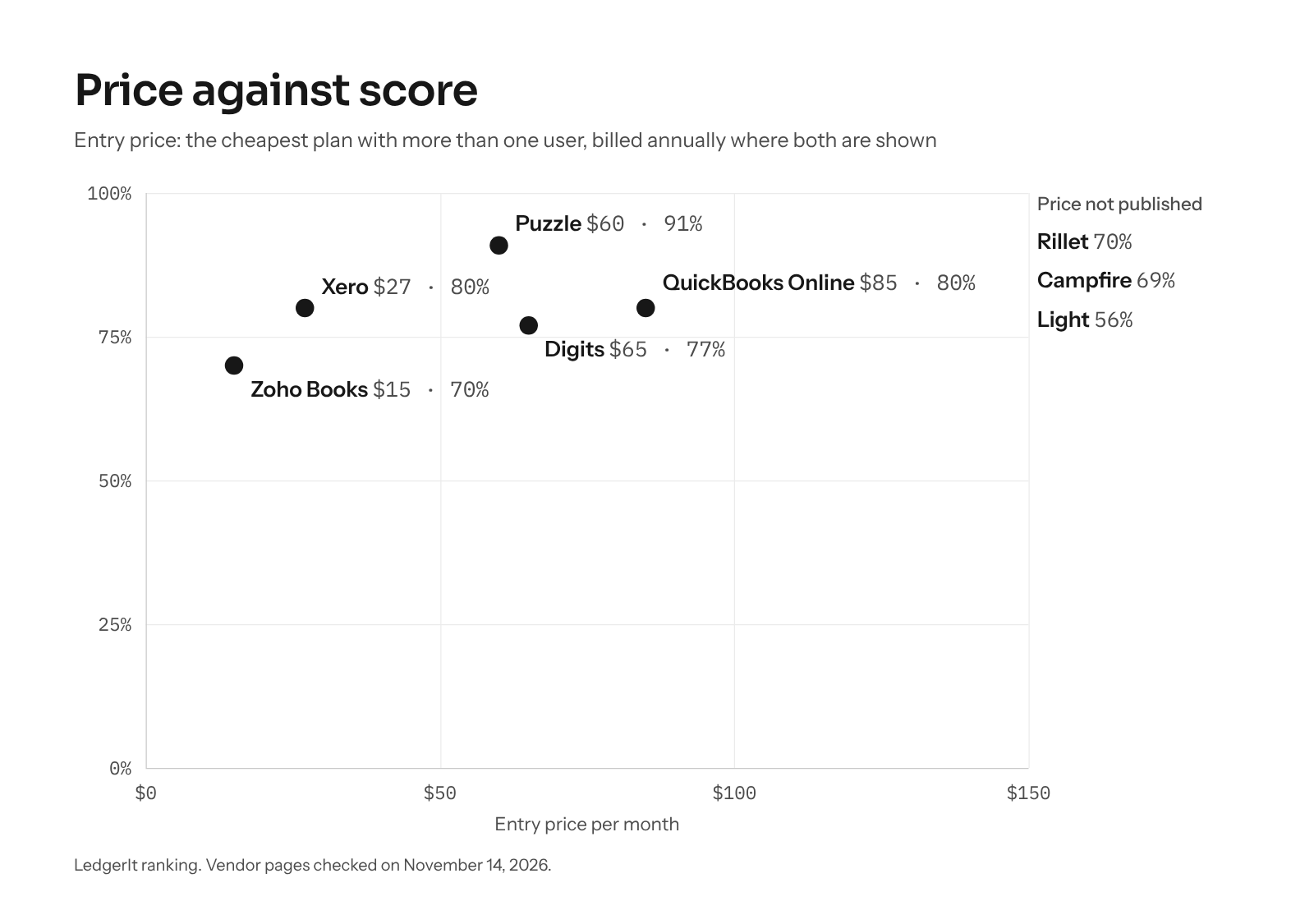
Every published plan, in US dollars a month. "Annual" is the monthly price when billed for a year; a blank means the vendor shows only a monthly price.
| Product | Plan | Annual | Monthly | What it includes |
|---|---|---|---|---|
| Puzzle | Starter | $25 | $30 | 1 seat |
| Puzzle | Core | $60 | $72 | 5 seats |
| Puzzle | Complete | $100 | $120 | Unlimited seats; revenue recognition |
| Puzzle | Scale | $300 | $360 | Unlimited seats |
| QuickBooks Online | Free | $0 | 1 user, no accountant access | |
| QuickBooks Online | Simple Start | $38 | 1 user plus 2 accountants | |
| QuickBooks Online | Essentials | $85 | 3 users plus 2 accountants | |
| QuickBooks Online | Plus | $140 | 5 users plus 2 accountants | |
| QuickBooks Online | Advanced | $340 | 25 users plus 3 accountants; revenue recognition | |
| Xero | Early | $27 | 20 invoices, 5 bills | |
| Xero | Growing | $59 | Automatic bank reconciliation | |
| Xero | Established | $97 | Multi-currency, projects | |
| Digits | Essentials | $65 | Unlimited seats | |
| Digits | Core | $100 | Unlimited seats | |
| Digits | Pro | $250 | Budget vs. actuals | |
| Zoho Books | Free | $0 | $0 | 1 user plus 1 accountant, revenue under $50K |
| Zoho Books | Standard | $15 | $20 | 3 users |
| Zoho Books | Professional | $40 | $50 | 5 users |
| Zoho Books | Premium | $60 | $70 | 10 users; revenue recognition, basic |
| Zoho Books | Elite | $120 | $150 | 10 users; revenue recognition, advanced |
| Zoho Books | Ultimate | $240 | $275 | 15 users |
Rillet, Campfire and Light sell by quote. The cheapest way to get revenue recognition built in, among published prices, is Zoho Books Premium at $60 a month, from invoices; from Stripe, it is Puzzle Complete at $100 a month.
How to choose
- You bill subscriptions through Stripe, some of them annual, and have no finance hire. Puzzle. Revenue schedules from Stripe come with Complete at $100 a month billed annually, and the bank and payroll integrations are direct.
- Your accountant, or the firm you are about to hire, works in QuickBooks. QuickBooks Online. Two accountant seats are free, and the ProAdvisor program trains accountants on it. Plan for Advanced at $340 a month, or a revenue app, once deferred revenue matters.
- You want the lowest bill and free seats for everyone. Xero at $27 a month, moving to Growing at $59 when you pass 20 invoices or want automatic reconciliation. Keep deferred revenue on a repeating journal until it is worth an app.
- You bill monthly, with no prepayments, and want the books to run themselves. Digits at $65 a month with unlimited seats, until you sign annual contracts.
- You are past Series A with a controller and contracts in a CRM. Rillet or Campfire, both sold by quote. Ask each for a price in writing and for how their revenue schedules handle your contract types. If you are comparing only the three best known, QuickBooks Online vs Xero vs Puzzle goes plan by plan.
Where LedgerIt fits
LedgerIt is accounting software for US Delaware C-corps backed by venture capital, starting as early as pre-seed, and it is not in the ranking above because we make it. It connects Mercury and Brex, posts Stripe as a subledger and payroll from Gusto, keeps deferred revenue and prepaid expenses on schedules, and runs a month-end close with a checklist and locked periods. See LedgerIt.
It is not for everyone. Do not use LedgerIt if you hold inventory or if your accountant needs to work in QuickBooks, Xero or Puzzle.
What to do this month
- Count your annual and multi-year contracts. If any customer prepays, you need deferred revenue, and that decides most of this list.
- Ask your accountant which ledger they work in, and whether they will work in another.
- List what you pay through: Stripe, your bank, your card program, payroll. Check each on the vendor's integrations page before you sign up.
- Start a free trial of your top two with last month's bank data, and see how much each categorizes without help.
- Lock last month once it is reconciled, in whichever product you choose, so a late edit cannot change a number you have already sent to investors.